
Regulatory framework: GOST 30826-2014
GOST 30826-2014 “Laminated Building Glass” sets requirements for protective and bullet-resistant glass used in construction. The main classifications applicable to security posts are:
- Class SM (resistance to mechanical impact): protection against impact and forced entry by hand or with tools. Classes SM1–SM5 range from a single sheet of laminated glass to a reinforced multilayer structure.
- Class ST (resistance to small arms): bullet resistance. Classes ST1–ST5 correspond to GOST R 51136-2008. ST2 — Makarov PM pistol; ST3 — Stechkin APS pistol.
- Class SV (blast resistance): for critical, high-security facilities.
SM classes: what you need and what is excessive
| Class | Test | Application | Structure |
|---|---|---|---|
| SM1 | 4.1 kg impact, 1 attempt | Residential, Class B offices | Laminated 44.2 |
| SM2 | 4.1 kg impact, 3 attempts | Unarmed checkpoints | Laminated 55.3 |
| SM3 | 4.1 kg impact, 5 attempts + sledgehammer | Guarded checkpoints, banks | Laminated 66.3 or P5B |
| SM4 | Axe, 5 strikes | High-security facilities | Multilayer 8–12 mm |
| SM5 | Chainsaw, 1.5 min | Prisons, special-purpose facilities | Multilayer 15–20 mm |
Standard sizes of security posts
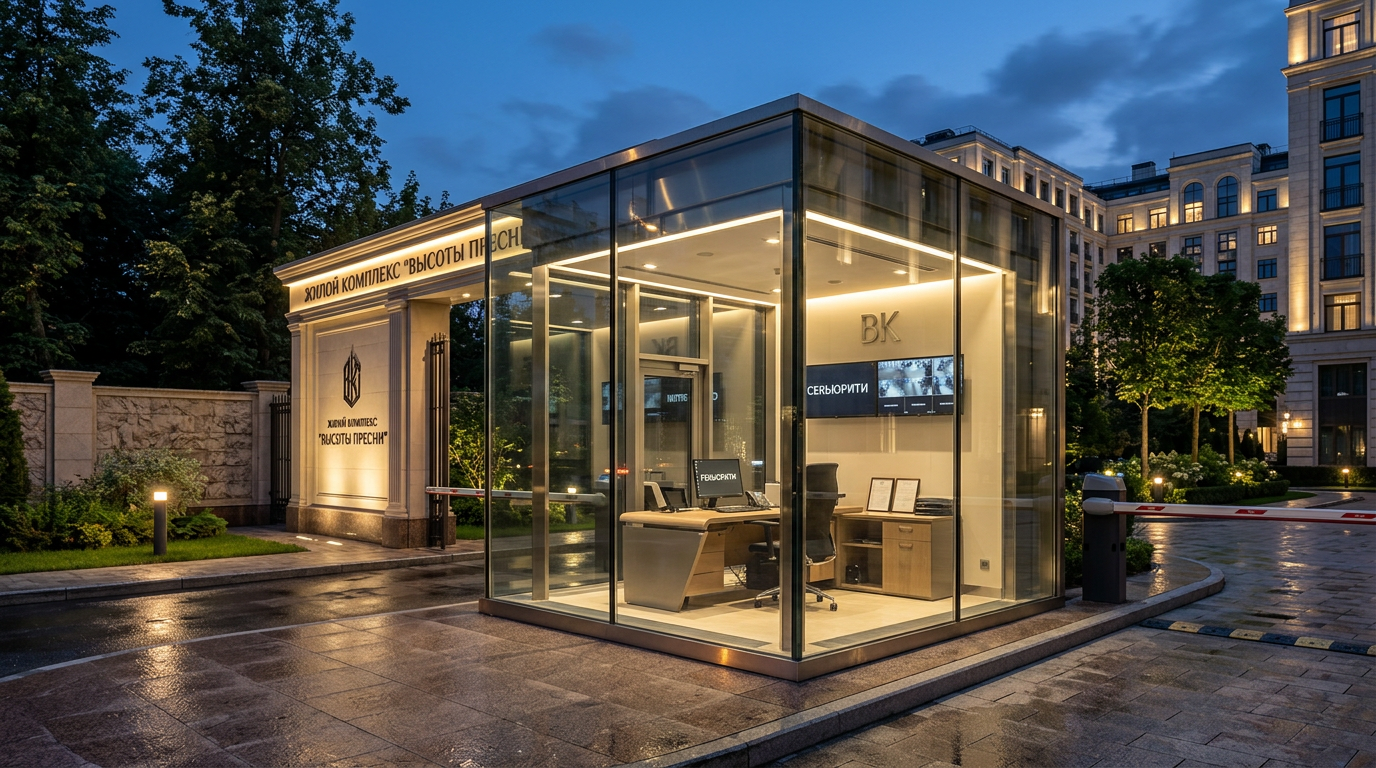
QUARTZ ECO manufactures glass security posts in the following standard sizes:
- Mini (2×2×2.5 m): 1 operator, pedestrian checkpoint. Budget: RUB 380,000–650,000
- Standard (3×3×2.8 m): 1–2 operators, checkpoint + access airlock. Budget: RUB 650,000–1,100,000
- Extended (4×4×3.0 m): combined security post and pass office. Budget: RUB 1,100,000–1,800,000
- Custom project: tailored to the specific site requirements
Thermal performance of a security post
A security post is a workplace occupied around the clock. Indoor climate requirements are stricter than for an ordinary room:
- Indoor temperature no lower than +18°C with an outdoor temperature of −26°C
- Heating: infrared ceiling heater (more efficient than convectors in small volumes) or an oil-filled radiator with a thermostat
- Insulated glass units: at least double-chamber IGUs with low-E coating and argon fill (Ug ≤ 0.8)
- Profile: thermally broken. A non-thermally-broken aluminum profile at −26°C will drop the frame temperature to −5…−8°C, meaning the operator would work in constant discomfort
- Ventilation: heat-recovery unit at 80–150 m³/h (eliminates the need to open windows in winter)
Electrical and building services
Typical engineering package for a glass security post:
- Power supply 220 V / 16 A (sufficient for lighting + heating + monitors)
- Low-voltage systems: panic button, CCTV, intercom, access control system (ACS)
- Lighting: LED panels providing 300–400 lx at the workstation
- Boom barrier or gate arm: controlled from the post (button or pedal)
- Emergency lighting: battery-powered luminaire (3-hour backup)
Installation and timeline
A glass security post is delivered as a ready-made module — on-site installation takes 1–3 days. Foundation: concrete slab or pile foundation (2–3 days). Utility connections: 1 day. Total from crew arrival to handover: 4–7 working days.
Factory production lead time: 3–6 weeks depending on the protection class and component availability.
We will quote a security post tailored to your site’s requirements
Manufactured in 3–6 weeks. Installation in 4–7 days. Protection class per GOST 30826-2014.
Get a quote