
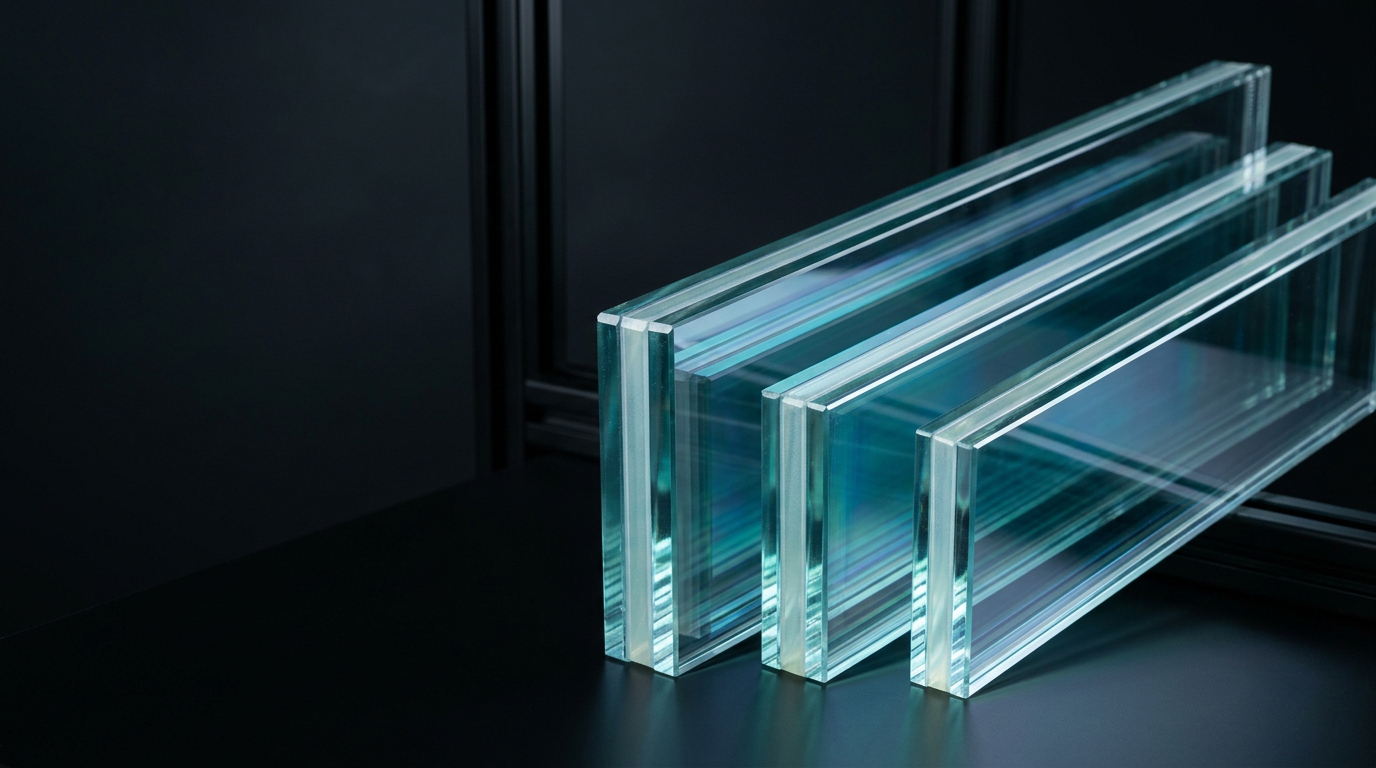
Three products that get mixed up on every project
When a client asks for "safety glass," builders offer three different options — sometimes lumped together in a single quote with no explanation of the difference. Yet tempered glass, laminated glass (triplex), and multifunctional insulated glass units are fundamentally different products, with different safety mechanisms, different code requirements, and prices that can vary by a factor of 4–6.
Tempered glass: what it is and where it's used
Tempered (heat-strengthened) glass is float glass that has undergone heat treatment: heating to 620–650°C followed by uniform air cooling. The result is a surface layer under compressive stress and a central zone under tensile stress. This raises bending strength by a factor of 3–5 compared to ordinary glass and changes the failure mode: instead of large sharp shards, it breaks into small blunt fragments.
Key characteristics:
- Bending strength: 120–200 MPa (float glass: 30–50 MPa)
- Impact resistance: per GOST 30698-2014, withstands a 0.5 kg ball dropped from a height of 1 m
- Thermal resistance: withstands temperature differentials up to 200°C (float glass: 30–40°C)
- Price: RUB 600–1,400 per m² depending on thickness (4–19 mm)
Limitation: once tempered, the glass cannot be cut, drilled, or edge-worked. All dimensions and holes must be set before heat treatment. In addition, tempered glass is not "safety glass" in the full sense — when it breaks, it still falls in fragments, which is critical for roof and sloped glazing.
Laminated glass: the "film holds the shards" principle
Laminated glass (triplex) consists of two or more panes bonded with a polymer interlayer (PVB or EVA) or a cast resin (SentryGlas, ionoplast). When broken, the shards are held by the interlayer — the glass "keeps its shape" and does not shed fragments below.
Standard designation per GOST 30826-2014: laminated 33.2 — two 3 mm panes + 0.38 mm interlayer; 44.2 — two 4 mm panes; 66.2 — two 6 mm panes, and so on. For roofs, the minimum is 44.2 or 55.2.
Characteristics of 44.2 laminated glass:
- Thickness: 8.76 mm (4 + 0.76 + 4)
- Weight: ~22 kg/m²
- Impact resistance: significantly higher than monolithic glass
- Sound insulation: +3–5 dB compared to monolithic glass of the same thickness
- Price: RUB 2,200–4,500 per m² (without tempering)
- With both panes tempered: RUB 4,500–8,000 per m²
Multifunctional IGU: warmth, light, and safety in one
A multifunctional insulated glass unit isn't a separate type of glass but a multi-chamber assembly that combines several functions: thermal insulation (low-E coating, argon/krypton fill), solar control (tinting, diffuse coating), and safety (one or two panes — laminated or tempered).
A typical formula for a winter garden: 4i-16Ar-4-16Ar-4i, where "i" is a low-E coating and "16Ar" is a 16 mm spacer bar filled with argon. Such a unit delivers a Ug value (heat transfer coefficient) of 0.6–0.8 W/(m²·K) — substantially better than a standard single-chamber unit (2.8–3.0 W/(m²·K)).
Price range for multifunctional IGUs:
- Single-chamber with low-E and argon: RUB 2,800–4,200 per m²
- Double-chamber 4i-16Ar-4-16Ar-4i: RUB 5,500–8,500 per m²
- With roof-grade laminated glass as the outer pane: +RUB 2,500–4,000 per m² over the base
- With solar-control coating (SNR 40%): +RUB 800–1,500 per m²
Where you can save, and where you can't
Sensible savings do exist. For example, for the vertical wall glazing of a winter garden, tempered glass in an IGU is sufficient — that's what the codes require, and there's no need to overpay for laminated glass here. However, there are areas where cutting costs directly contradicts the codes:
You cannot cut corners on the following:
- Roofs and sloped elements — laminated glass only (required by SP 20.13330.2017, section 10.3). Substituting ordinary tempered glass is a violation that gets flagged during insurance claims.
- Load-bearing glass elements — SentryGlas laminated glass or VSG with ionoplast, engineered per GOST 33079.
- Glazing above 6 m in height — tempered glass is mandatory; single monolithic glass is prohibited.
- Glazing near children's play areas — laminated glass regardless of height.
Where reasonable optimization is possible:
- Interior partitions in non-traffic zones — ordinary tempered glass.
- Side vertical walls up to 3 m in height — single-chamber IGU with tempered glass.
- Interlayer type in laminated glass — PVB is sufficient for most private projects; EVA and SentryGlas are needed under impact loads.
Comparison table and practical takeaway
When designing a winter garden or a glass house, we recommend the following zone-by-zone breakdown:
- Roof: laminated glass 44.2 with a tempered outer pane — mandatory
- Sloped façades (>15°): laminated glass, no less than 33.2 — mandatory
- Vertical walls: tempered glass in a double-chamber IGU with low-E — optimal
- Entrance groups, doors: tempered 8–10 mm or laminated 33.2 — chosen by design
- Multifunctional IGUs: for heated winter gardens — mandatory when the calculated U-value is ≥ 1.4
We'll specify the right glazing type for the codes and your budget
We'll identify where you can save without risk and prepare a full cost estimate for your project.
Get a quote