
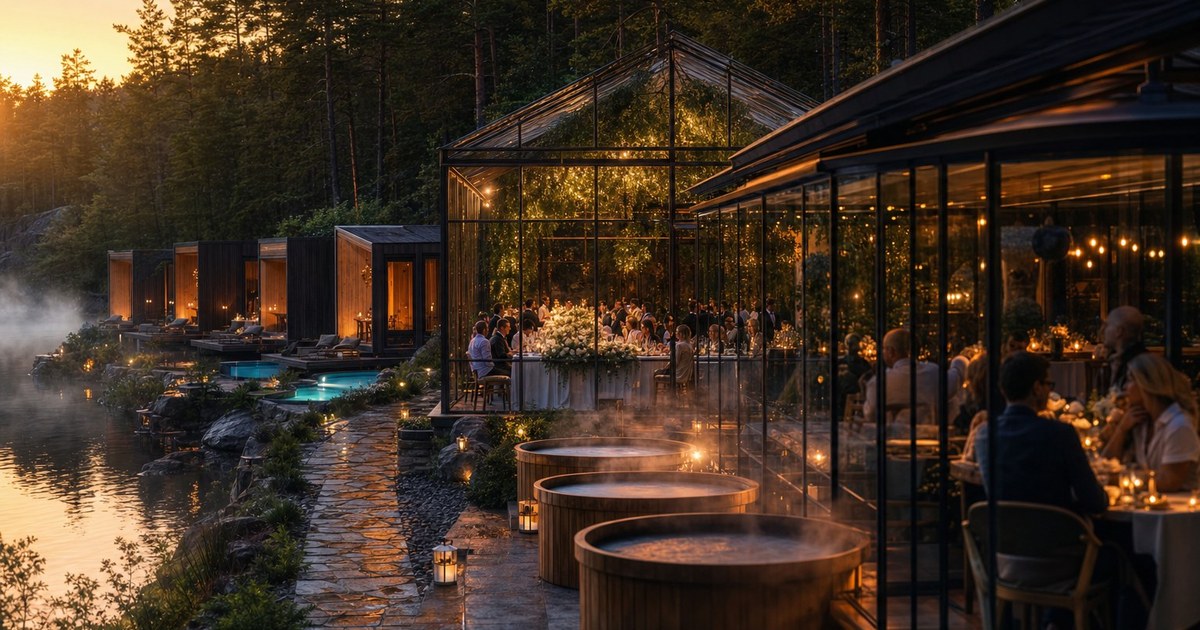
Base model: an 8-module glamping resort
Let's take a typical project — a glamping resort with 8 glass modules of 28 m² each, a shared restaurant pavilion and a spa area. Location: the Moscow Region, 1.5 hours from Moscow.
Project investment
| Item | Amount, RUB million |
|---|---|
| 1-hectare recreational plot | 4–8 |
| 8 glass modules of 28 m² | 14.4 (1.8 each) |
| Restaurant pavilion, 80 m² | 5,5 |
| Spa pavilion, 40 m² | 3,2 |
| Utilities and engineering | 3 |
| Landscaping and pathways | 2 |
| Furniture, textiles, tableware | 2,5 |
| Launch marketing | 0,8 |
| Total investment | 35,4–39,4 |
Revenue model
- Average nightly rate: price on request
- Summer occupancy (May–September): 80%
- Shoulder-season occupancy (March–April, October): 50%
- Winter occupancy (November–February): 35%
Weighted average annual occupancy: 55%. Price on request.
Additional revenue from the restaurant and spa: +30% = Price on request.
Total annual revenue
Operating expenses
- Staff (3–4 people): price on request
- Food procurement: price on request
- Utilities and maintenance: price on request
- Marketing and advertising: price on request
- Taxes and fees: price on request
- Maintenance reserve: price on request
- Total OPEX: Price on request
Profit and payback
Net annual profit
Price on request 37 / 14 = 2.6 years = 32 months
The service life of the glass modules is 50+ years with minimal maintenance. The project's 10-year IRR is approximately 35–40% per annum.
What improves payback
- Waterfront location (+15% to the rate)
- Scenic setting (mountains, forest, fields) (+10% to the rate)
- Distinctive architecture (Instagram effect) (+8% to occupancy)
- Spa and restaurant with local cuisine (+15% average check)
What increases risk
- Difficult logistics for guests (more than 2 hours from a major city)
- No attractions within a 30 km radius
- Seasonality with no winter program (banya, snowmobiles, hunting)
- Weak marketing — no active presence on Booking, OneTwoTrip and other aggregators