
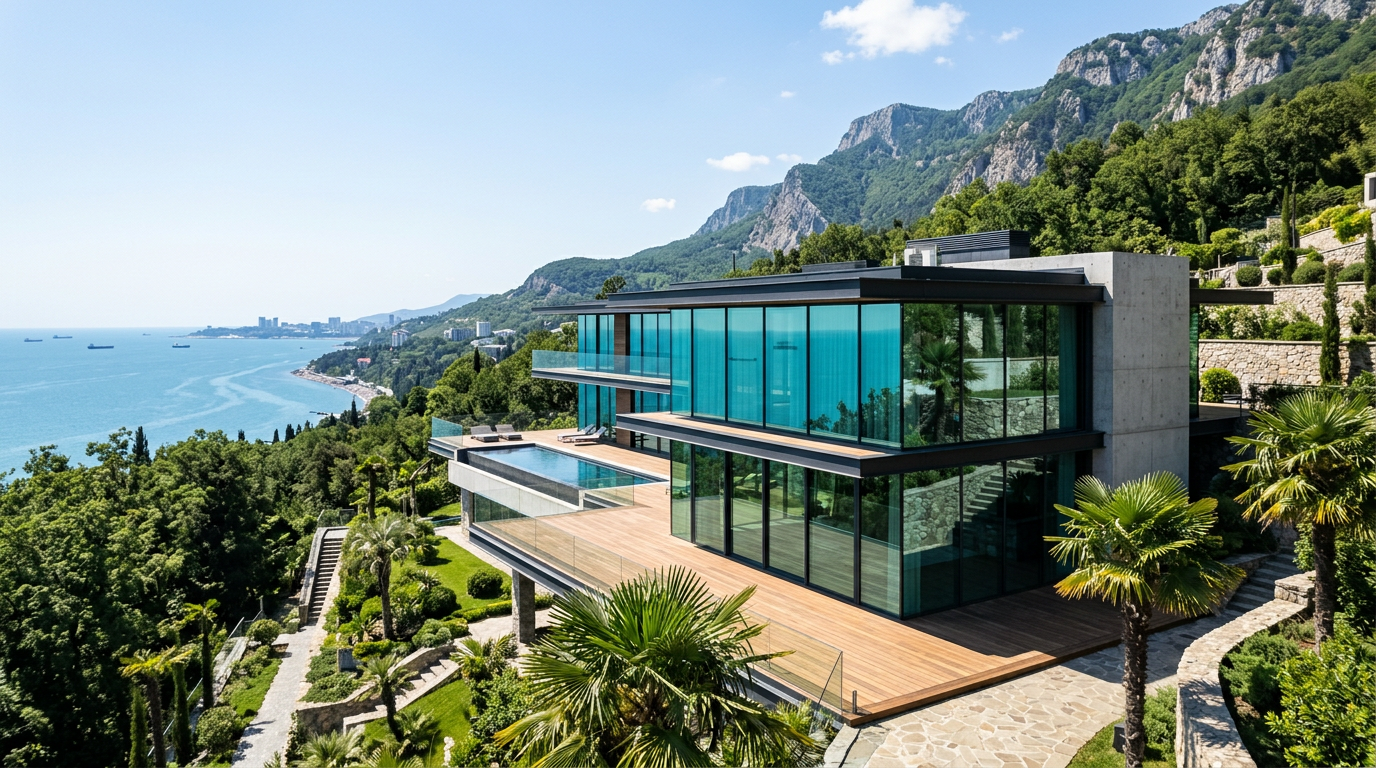
Climate parameters: Sochi vs. Moscow
Key differences of the southern climate for glazing design:
| Parameter | Moscow | Krasnodar | Sochi |
|---|---|---|---|
| Design summer temperature | +26°C | +35°C | +32°C |
| Solar radiation, kWh/m²·year | 1 050 | 1 450 | 1 620 |
| Summer UV index | 4–5 | 7–8 | 8–10 |
| Design winter temperature | −26°C | −15°C | −7°C |
| Snow load zone | IV (240 kg/m²) | II (80 kg/m²) | I (50 kg/m²) |
Conclusion: in the south, the main task of glazing is solar control, not thermal insulation. This fundamentally changes the choice of the insulated glass unit.
How solar-control glass works
Ordinary glass transmits 80–85% of solar radiation, including visible light, near infrared (heat) and UV. Specialized coatings allow these flows to be managed independently.
Key characteristics of solar-control glass:
- SNR (Solar Neutrality Ratio) / g-value: the share of solar heat passing through the glass. An SNR of 20% means only 20% of solar heat enters the interior. The optimum for the south: SNR 20–35%.
- VT (Visual Transmittance): visible light transmission. Good solar-control glass: VT 60–70% at SNR 25–30% — light inside, heat outside.
- LSG (Light-to-Solar-Heat Gain): the ratio of VT to g-value. A value >2 means “more light, less heat” — the optimum.
- UV blocking: modern low-E glass blocks 95–99% of UV-A and UV-B. That protects furniture, fabrics and skin.
The myth of the “hot glass house”
Where does the myth come from? People see greenhouses or cheap glass inserts in houses from the 1990s — single-pane glass without coatings at +35°C outside creates +60–70°C inside. That is a fact.
But a modern double-chamber IGU with a solar-control coating (SNR 25%) behaves differently. At +35°C outside and a solar load of 800 W/m², ordinary glass lets 680 W/m² into the room, while an SNR unit lets in 200 W/m². The difference is 3.4 times. That is why an air conditioner in a properly glazed house runs significantly less than in a house with ordinary glass.
Calculation for Sochi: choosing the IGU
For Sochi, the optimal IGU specification is:
- Single-chamber IGU (the roof does not require multi-chamber — snow load is negligible): 6 SGG Cool-Lite S 1.1 — 16Ar — 4
- Characteristics: Ug = 1.2; g = 0.24 (SNR 24%); VT = 70%; UV blocking 99%
- For west- and south-facing façades: add external blinds or an interior solar-control film
For Krasnodar (colder winter, −15°C):
- Double-chamber: 6 SGG Cool-Lite SKN 176 — 14Ar — 4 — 10Ar — 4i
- Ug = 0.7; g = 0.25; VT = 68%. A balance of solar control and winter thermal insulation.
Ventilation: the key to comfort
No glass can replace ventilation. For a southern climate, the following are essential:
- Operable elements totaling at least 15–20% of the glazing area
- Placement of openings: bottom (intake) + top (exhaust) — natural convection
- Night cooling: in Sochi and Krasnodar, nighttime temperatures often drop to +18–22°C — an opportunity to “flush” the house with cool air without air conditioning
- Heat recovery: in Krasnodar during winter — justified
A few words on energy efficiency
A properly designed glass house in the south, with informed management (nighttime ventilation, closing blinds in the morning), can have lower air-conditioning bills than the brick house next door. Glass with SNR + a heat pump + a heat recovery unit is a system, not a set of separate solutions.
On QUARTZ ECO projects in southern regions, we use only solar-control IGUs with a g-value below 0.35. Without this, we do not take on southern projects. This is a matter of principle.
Let’s design a glass building tailored to your climate
Moscow, Krasnodar, Sochi — we’ll select the IGU and ventilation for your specific region.
Get a quote