
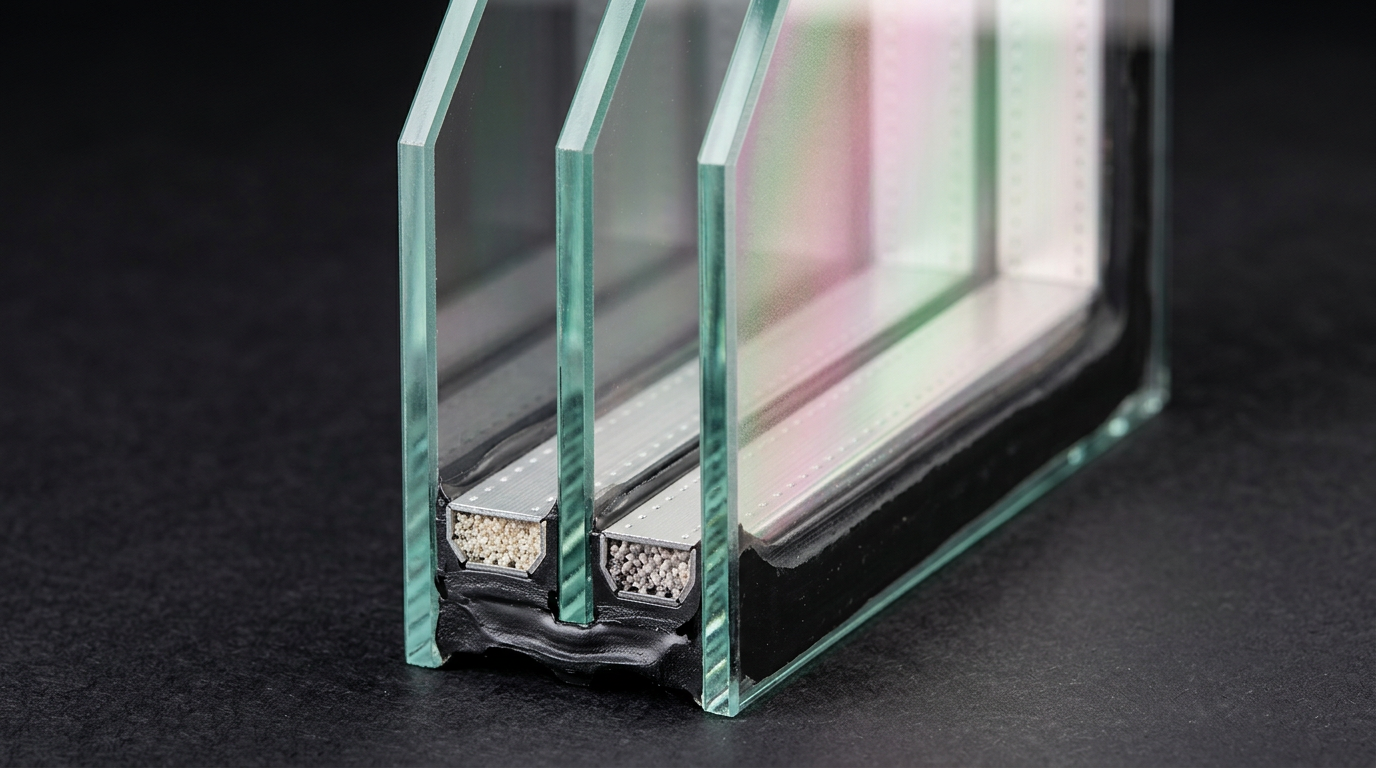
The basic structure of an IGU formula
An IGU formula is read from left to right — from the outer pane to the inner one. Each number is the glass thickness in mm, letters indicate the type of coating or gas, and hyphens separate the elements.
Let's break down the formula 4i-16Ar-4-14Ar-4i element by element:
- 4 — thickness of the first (outer) glass pane: 4 mm
- i — low-E coating on this pane (from "emissivity")
- 16Ar — 16 mm spacer bar filled with argon (Ar)
- 4 — middle glass pane, 4 mm (uncoated)
- 14Ar — second 14 mm cavity with argon
- 4i — inner 4 mm pane with low-E coating
In total: a triple-pane, double-cavity IGU with two low-E coatings and both cavities filled with argon.
Low-E coating: what it is and why it matters
Low-E (low emissivity) is a thin metal deposition (silver plus metal oxides) applied to the glass surface. Its job is to reflect long-wave infrared (thermal) radiation. In winter it reflects heat back into the room; in summer it partly reflects solar heat back outside.
Types of coatings:
- Soft low-E (K-glass, i-glass): applied in a vacuum chamber, must be protected inside the IGU. Emissivity ε = 0.03–0.04. Better performance, but less durable if the IGU seal is broken.
- Hard low-E (pyrolytic): applied to molten glass, more durable, ε = 0.15–0.20. Suitable for single-cavity IGUs.
The correct placement of low-E in a double-cavity IGU is on surface 2 (the outer face of the middle pane) or surface 5 (the inner face of the inner pane). This maximizes the heat-retention effect.
Argon vs. krypton: is it worth paying more?
Gas fill reduces heat transfer between panes (convection + thermal conductivity: air λ = 0.024 W/(m·K), argon λ = 0.016, krypton λ = 0.0088).
| Gas | λ, W/(m·K) | U-value reduction | Additional cost |
|---|---|---|---|
| Air | 0,024 | — | 0 |
| Argon (Ar) | 0,016 | −12–15% | +180–350 RUB/m² |
| Krypton (Kr) | 0,0088 | −25–30% | +900–1,800 RUB/m² |
| Xenon (Xe) | 0,0055 | −35–40% | +5,000–8,000 RUB/m² |
For most winter gardens, argon is the optimal choice. Krypton is justified with narrow cavities (9–12 mm) or in a passive house with strict U-value requirements. Xenon is exotic and rarely used in construction.
Ug — heat transfer coefficient: what it means
Ug (U-value for glazing) is the heat transfer coefficient of the IGU, W/(m²·K). The lower, the better the insulation. Don't confuse it with the U-value of the entire window unit (Uw), which includes the frame profile.
- Single-cavity, no low-E: Ug = 2.8–3.0
- Single-cavity with low-E, air: Ug = 1.8–2.0
- Single-cavity with low-E, argon: Ug = 1.4–1.6
- Double-cavity with low-E, argon: Ug = 0.6–0.8
- Double-cavity with 2× low-E, krypton: Ug = 0.4–0.5
For a winter garden in Moscow we recommend Ug ≤ 0.8 — this meets the requirements of SP 50.13330 (Russian building code) for reduced thermal resistance in climate zone III.
Edge (spacer bar): what's hidden behind the "aluminum" seam
The spacer bar separates the glass panes around the perimeter. A classic aluminum spacer is a "thermal bridge": because of aluminum's high thermal conductivity (λ = 160 W/(m·K)), a condensation zone forms along the edge of the IGU.
Alternatives:
- Plastic spacer (Warm Edge, TPS): λ = 0.2–0.3 W/(m·K). Reduces edge heat loss by 25–40% and eliminates condensation. Added cost: +200–400 RUB/m² of IGU. Recommended for all winter gardens.
- Stainless steel: λ = 14 W/(m·K) — better than aluminum, worse than plastic. A middle-ground option.
What's marketing, and what actually matters
What actually matters: whether there is a low-E coating and its correct placement, the type of gas fill, the Ug value, and the type of spacer bar (Warm Edge or not).
Marketing claims that need clarification:
- "Multifunctional IGU" — ask what exactly is meant (tinting? low-E? solar control?)
- "Energy-saving glass" — ask for the Ug value
- "Triple-cavity IGU" — check whether it has a low-E coating. Three cavities without low-E perform worse than two cavities with low-E.
We'll select an IGU with the right Ug for your project
We'll calculate the optimal IGU based on thermal performance, cost, and building codes for your region.
Get a quote