
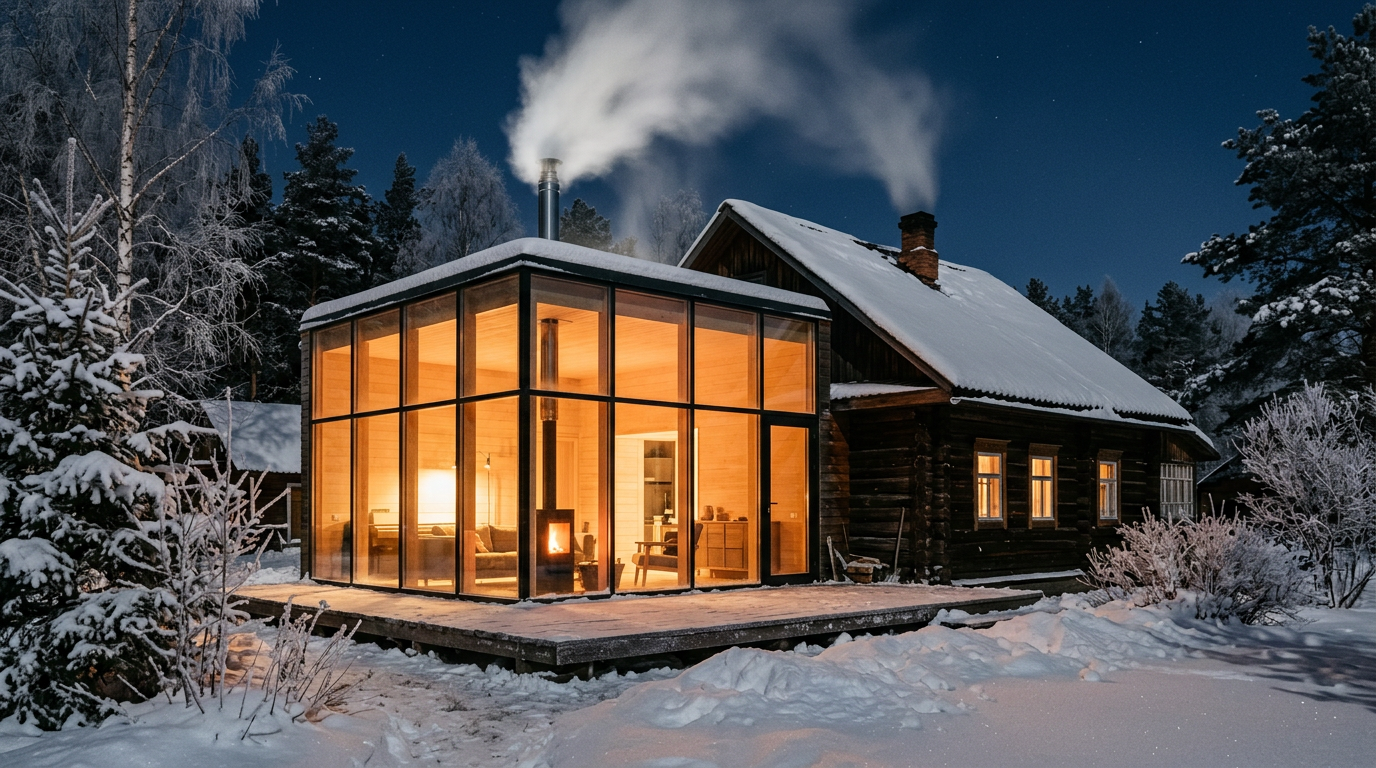
Starting point: Moscow climate parameters
The design winter temperature for Moscow per SP 131.13330.2020 (Building Climatology): outdoor air −26°C (absolute minimum −42°C), design heating-season temperature −3.1°C. Heat loss through the enclosure is calculated using the difference between indoor temperature (+18–22°C) and the design outdoor temperature (−26°C) — that is, ΔT = 44–48 K.
This has to be understood before design starts: a glass extension in the Moscow climate is a fundamentally different object than one in Sochi (design temperature −7°C) or Berlin (design temperature −15°C). Here a “cold orangery” with no heating at −26°C means a frozen space with frost on the glass and a risk of pipes freezing.
The heat-loss formula for glazing
Heat loss through an enclosing structure is calculated by the formula:
Q = U × S × ΔT
Where: Q — heat loss (W), U — thermal transmittance of the IGU (W/(m²·K)), S — glazing area (m²), ΔT — temperature difference (K).
Let's calculate for a typical 20 m² extension (floor area), 3 m high, glazed on three sides, with a glass roof:
- Glass wall area: ~50 m²
- Glass roof area: ~25 m²
- Total glazing: ~75 m²
| IGU type | U, W/(m²·K) | Heat loss, W | kWh per season | RUB/year (RUB 8/kWh) |
|---|---|---|---|---|
| Single-chamber (standard) | 2,8 | 9 240 | ~18 500 | ~148 000 |
| Single-chamber with low-E | 1,6 | 5 280 | ~10 560 | ~84 500 |
| Double-chamber with low-E, argon | 0,8 | 2 640 | ~5 280 | ~42 200 |
| Double-chamber, low-E, krypton | 0,5 | 1 650 | ~3 300 | ~26 400 |
Myths about the “cold orangery”
Myth 1: “A cold orangery is cheaper to build and to maintain.”
Partly true. Building an unheated space really is cheaper: no heating system, cheaper IGUs are possible. But “maintenance” is debatable. Without heating at −26°C, water left in pipes bursts metal-plastic piping. Condensate cycling through 0°C destroys joints. The space can't be used in winter — it's just a storage room with a nice view. The savings are illusory.
Myth 2: “A winter garden has to be opened up in summer, otherwise it overheats.”
Only true with poor design. A winter garden with opening top vents (a minimum of 15% of the roof area is recommended) and SNR40 solar-control glass coating is comfortable in summer at +28–32°C indoors. Without ventilation, temperatures can reach +55°C — that is a design error, not an inevitability.
Myth 3: “A glass extension breeds condensation and mold.”
Condensation only occurs under two conditions: a cold profile (aluminum without a thermal break) or an IGU with U > 1.4 W/(m²·K). With the correct profile (thermally broken, Ψ ≤ 0.04 W/(m·K)) and a double-chamber IGU with low-E, condensation is eliminated even at −26°C outdoors.
The role of the profile in heat loss: what calculations miss
Most online calculators only count heat loss through the glass, ignoring the profile and joint details. Yet losses through the “thermal bridges” of an aluminum profile without a thermal break can account for 25–40% of total losses.
The Tatprof TP-50 profile (thermally broken) has Ψ = 0.038 W/(m·K). Schüco AWS 90 — Ψ = 0.028 W/(m·K). A non-thermally-broken profile — Ψ = 0.15–0.22 W/(m·K). For an extension with a 28 m perimeter and 6 m height (~56 linear meters of profile), the difference in losses through the profile alone is 550–1,000 W, or 1,100–2,000 kWh per season (~RUB 9,000–16,000/year).
Heating a winter garden: the right systems
For a 20 m² extension with correct IGUs (U = 0.8 W/(m²·K)) at ΔT = 44 K, the load is ~2,640 W. That is the heater capacity that needs to be covered. The options:
- Hydronic underfloor heating (+ a warm skirting) — even heat, no hot-air currents, no condensation at the bottom of the glass. Optimal.
- Electric warm skirtings — quick to install, infrared heat, built-in thermostat. Good for smaller extensions.
- Convectors under the windows — the classic solution; creates an “air curtain” in front of the glass and reduces condensation. Cheaper than underfloor heating.
- Warm-air heating — not suitable: hot air rises, feet stay cold.
Final recommendations
For a glass extension in the Moscow Region at a design temperature of −26°C:
- IGUs: at minimum, double-chamber with low-E and argon, Ug ≤ 1.0 W/(m²·K)
- Profile: thermally broken only, Ψ ≤ 0.04 W/(m·K)
- Heating: underfloor heating plus skirting convectors or electric skirtings
- Ventilation: opening top vents of at least 15% of the roof area
- Solar control: low-E coating or roller blinds in the roof
Done correctly, heating a 20 m² extension will cost RUB 2,500–4,000 per month from December through February — comparable to heating a warm garage.
We'll select the IGU and heating system for the climate of your region
We'll run a thermal calculation per SP 50.13330, select the profile, and provide heating recommendations.
Get a quote