
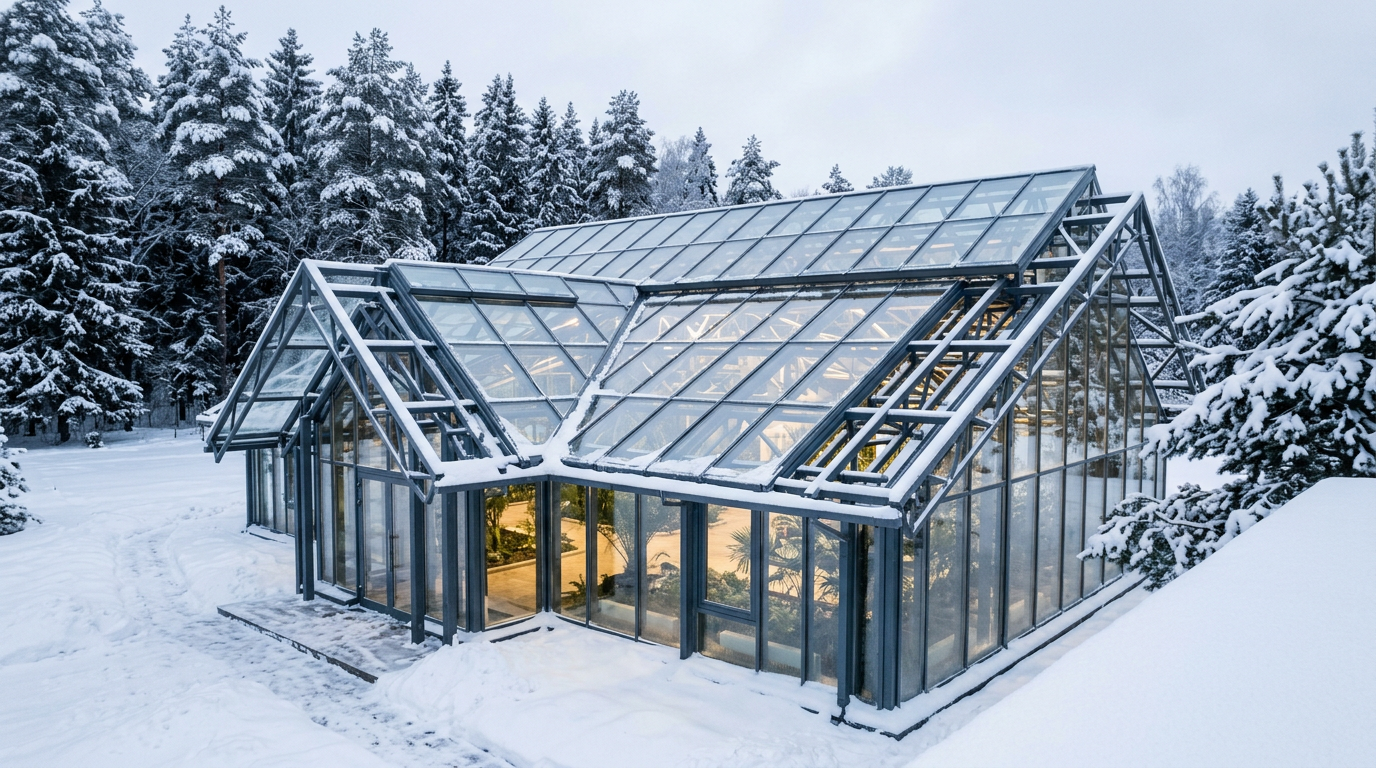
Snow zones of Russia: where Moscow sits
Under SP 20.13330.2017 “Loads and Actions” (Russian building code), the territory of Russia is divided into 8 snow zones. Moscow and most districts of the Moscow Region fall into snow zone IV, with a characteristic snow load on a horizontal surface of S₀ = 240 kg/m² (2.4 kPa).
For comparison: Sochi is zone II (80 kg/m²), Krasnodar is zone III (120 kg/m²), St. Petersburg is zone III (120 kg/m²), and Vorkuta is zone VIII (560 kg/m²). Moscow is not a record-holder, but the load is three times higher than in Sochi.
Design snow load: formula and coefficients
The design load on the roof is determined by the formula from SP 20.13330.2017:
S = S₀ × µ × Ce × Ct
Where: µ is the roof shape coefficient (depending on the slope angle), Ce is the wind exposure coefficient for snow drift (0.85–1.0), and Ct is the thermal coefficient (for heated buildings, 0.8–1.0).
- Horizontal roof (µ = 1.0): S = 240 × 1.0 × 1.0 × 1.0 = 240 kg/m²
- Pitched roof at 30° (µ = 0.5): S = 240 × 0.5 = 120 kg/m²
- Pitched roof at 60° (µ = 0): snow does not accumulate
The practical takeaway: a pitched winter garden roof with an angle greater than 45° cuts the design load in half. At angles above 60°, snow slides off on its own and snow load is not considered. A steep roof is not only an aesthetic choice but also an engineering solution for reducing loads.
Wind load in Moscow
Moscow is located in wind zone III, with a characteristic wind pressure of W₀ = 0.38 kPa. For a glass facade, wind is the key horizontal load. Wind load calculation for a facade (building up to 10 m tall, terrain type B):
- Characteristic wind load: 0.38 × 0.65 = 0.247 kPa (25 kg/m²)
- Design value (with a safety factor of 1.4): 0.35 kPa (35 kg/m²)
For a glass facade 3 m tall with a 1.5 m span: the load per span is 0.35 × 3 × 1.5 = 1.58 kN. This is precisely the value that determines the minimum glass thickness and the spacing of the profile mullions.
Winter garden frame design: implications for cross-sections
For a typical glass roof with a 3.0 m span under a load of 240 kg/m², the total load on a beam will be:
- Snow: 240 × 3.0 = 720 kg/lin. m × 1.5 m (rafter spacing) = 1,080 kg
- Self-weight of the glass (44.2 + IGU): ~50 kg/m² × 3 × 1.5 = 225 kg
- Total: ~1,300 kg on a 3 m rafter beam
For such a load with an aluminum profile, you will need either a dedicated structural beam with a cross-section of at least 100×100 mm and a wall thickness of 5 mm, or a powder-coated steel rectangular tube. A standard 50 mm facade profile is not sufficient here — a frequent mistake when copying “European projects.”
How snow load affects the budget
Properly accounting for snow zone IV loads increases the cost of a winter garden roof structure by 25–40% compared with a “southern” solution:
- Reinforced profile (structural beams): +15–20% to the profile cost
- 55.2 laminated roof glass instead of 33.2: +8–12% to the glass cost
- Additional anchor points and perimeter beams: +5–8% to the installation cost
A project “saved” by understating loads may not survive its first Moscow winter. The fix is dismantling and replacing the entire roof structure.
Practical recommendations
- Design a roof slope of at least 20° — this reduces µ to 0.7–0.8 and helps snow slide off
- Use structural roof beams with a design deflection of no more than L/250
- Roof glass: 55.2 laminated glass for spans over 2 m, 44.2 laminated glass for spans under 2 m
- Provide a heating system for the roof drainage (heat-trace cable, 20–30 W/lin. m)
- During design, obtain calculations from a structural engineer certified to SP 20.13330
We will engineer the structure for snow zone IV loads
We will perform calculations to SP 20.13330 using the actual loads for Moscow and the Moscow Region.
Get a quote