
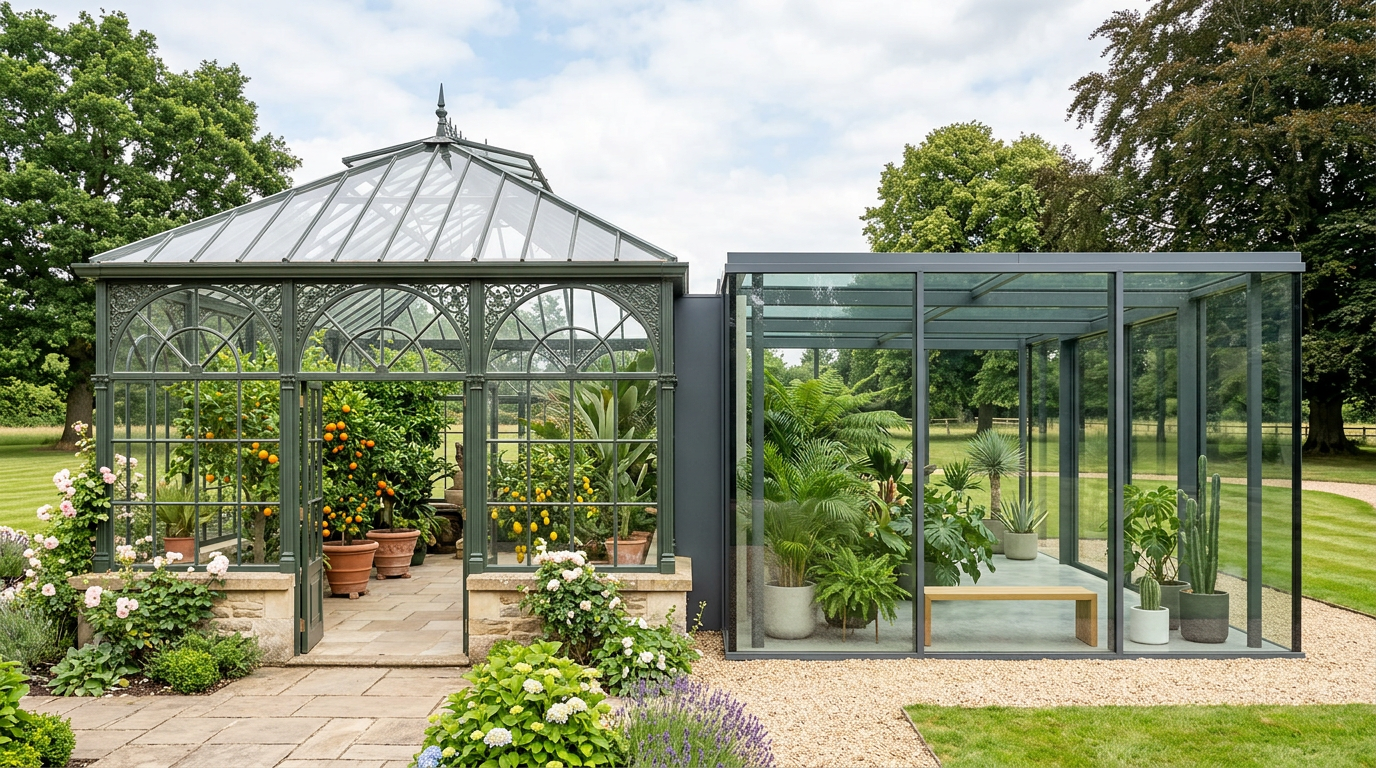
The fundamental difference: who takes priority in the space
An orangery is a structure intended primarily for growing plants. People are guests here. The microclimate regime is dictated by the requirements of the crops: high humidity of 65–85%, with temperature set by plant type (+5°C for subtropicals, +18–22°C for tropicals).
A winter garden is a residential or semi-residential space in which plants are present as a decorative element. People come first. The microclimate is tuned for comfort: temperature +18–24°C, humidity 40–60%, lighting — natural, plus artificial light for evening use.
This distinction runs through everything: from the design and choice of glazing to the list of suitable plants.
Microclimate: parameter table
| Parameter | Orangery | Winter garden |
|---|---|---|
| Winter temperature | +5 to +18°C (depending on plant type) | +18 to +24°C |
| Humidity | 65–85% | 40–60% |
| Ventilation | active mechanical ventilation required | opening vents + heat recovery |
| Lighting (lux) | 10,000–50,000 lx | 300–1,000 lx |
| Watering | automated, with drainage | manual or drip |
| Heating | underfloor soil heating + radiators | underfloor heating + convectors |
Glazing requirements: the key difference
In an orangery, the glass performs two functions: it delivers maximum natural light and retains heat. Subtropical plants require high light transmittance — no less than 70–75%. This means: minimal coatings, clear glass, and sun protection provided only by blinds, not by tinted glass.
In a winter garden, the glass must also protect against summer overheating. The optimum: glass with a solar-control low-E coating such as SNR40 (transmits 45% of solar heat, does not alter color). Light transmittance still remains high — 70%+.
A common requirement for both structures: the roof must be laminated glass only (SP 20.13330, Russian building code). The profile must be thermally broken.
Which plants suit a winter garden in Moscow
At a temperature of +18–22°C and moderate humidity of 50–60%, the following thrive in a winter garden:
- Subtropicals: lemon, mandarin, oleander, hydrangea, camellia (require a winter drop to +8–12°C)
- Decorative tropicals: weeping fig (Ficus benjamina), monstera, dieffenbachia, anthurium — with constant warmth
- Palms: parlor palm (Chamaedorea), Livistona (slow-growing, undemanding)
- Succulents and cacti: enjoy the bright light of a winter garden and require a dry winter rest period
Orangery: structural specifics
A full-fledged orangery requires additional engineering systems:
- A drainage floor sloped toward drains (1–2%)
- A misting system or ultrasonic humidification
- Supplementary lighting: LED grow lamps (red 660 nm + blue 450 nm), 80–120 W/m²
- Automatic watering with a timer and soil-moisture sensors
- Exhaust ventilation (minimum air change rate of 1.5 per hour)
The engineering budget for an orangery is 30–50% higher than for a comparable winter garden. At the same time, an orangery cannot be used as a living area due to high humidity — mold and condensation are inevitable.
What to choose: practical takeaway
The choice is simple once you answer one question: who will be inside — people or plants? If you want a “green corner” within a living space, that is a winter garden. If the goal is to grow exotics, citrus, and tropical species on a serious scale, that is an orangery with the corresponding engineering.
QUARTZ ECO primarily designs winter gardens and pavilions. For orangery projects, we recommend consulting a botanist on microclimate requirements before beginning structural design.
We’ll design a winter garden tailored to your needs
We will determine the optimal concept, glazing type, and engineering for your site.
Get a quote